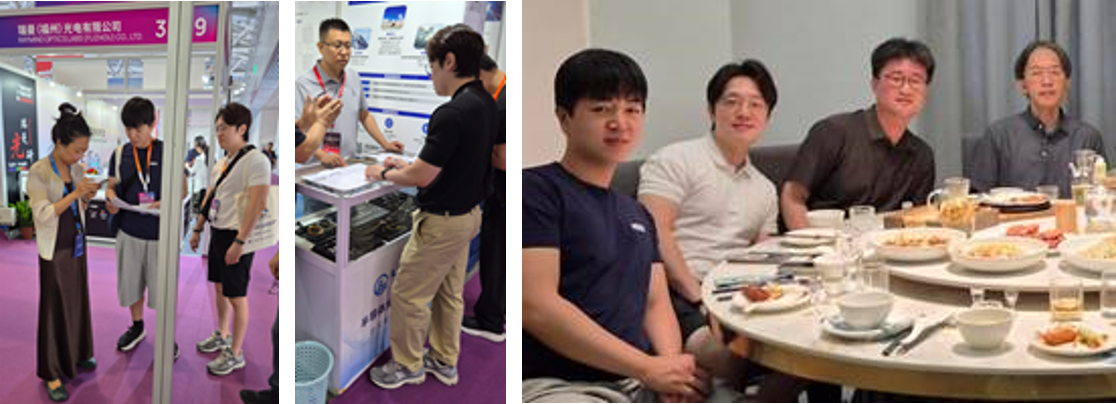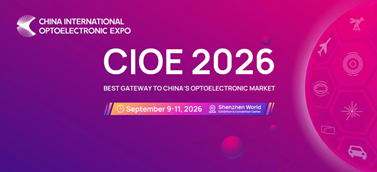
Meter-Lab's research team visited CIOE 2026, held from September 9 to 11 at the Shenzhen World Exhibition and Convention Center in China. CIOE is one of the world's largest exhibitions covering the whole optoelectronics industry — information and communication, precision optics, lasers, infrared, sensing, displays, and AR/VR. This year, more than 4,000 companies from over 30 countries took part. The show ran alongside the International Integrated Circuit Innovation Expo (IICIE) and Elexcon, covering 320,000 square meters with more than 240,000 visitors. Meter-Lab develops spectral-based thickness and shape measurement equipment, so our team visits this show every year to check on competing technologies and market trends.
The first thing we noticed was the turnout in the spectral-based thickness measurement field. As in the previous year, many companies with spectral reflectometers and ellipsometers took part with large booths, and the overall scale stayed about the same or grew a little. Among them, a handful of companies that make everything — from core optical parts to finished measurement systems — stood out even more clearly. This tells us that interest in this field is still strong, and the market is growing along with it.
The second trend we noticed was hyperspectral technology being used in new ways. In past years, these demos mostly focused on sorting materials. This time, we saw for the first time a demo that showed a map of thin-film thickness across a wafer surface. The measurement range was still smaller than what Meter-Lab can do. But since Meter-Lab already uses hyperspectral methods to measure thin-film thickness, this showed that competing technologies are starting to move into our space. AR/VR optical parts also had a strong presence at the show. We saw several booths showing parts like optical waveguides and Micro LEDs, which go into smart glasses.
The third trend was the growth of China's optical component industry. More companies now supply precision scanning parts like motorized stages, galvo mirrors, and optical switches, and their performance has caught up to widely used existing products. Many of them also compete on price. We also saw many companies offering full lines of optical components, each keeping its own area of focus while competing with others. Small, highly integrated optical parts — like metalenses, waveguides, microlens arrays, fiber bundles, and multi-faceted prisms — were shown in large numbers, giving us useful ideas for future R&D.