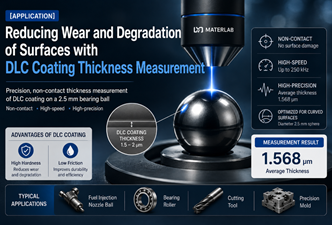
DLC (Diamond-like Carbon) is a thin, non-crystalline carbon film. It has some sp3 bonds, like diamond does. DLC is very hard and has low friction. Because of this, it protects surfaces from wear and damage. Companies coat it onto parts that rub against other parts a lot, like fuel injector nozzle balls, bearing rollers, cutting tools, and precision molds.
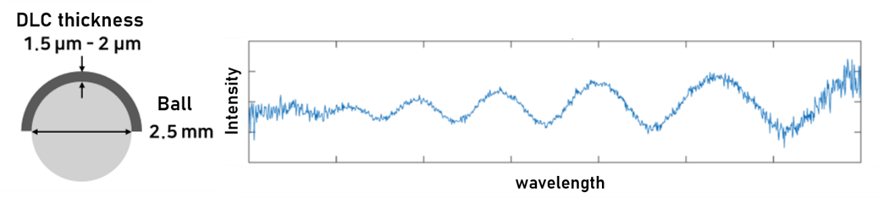
The sample we measured was a very small bearing ball, only 2.5 mm across. Its surface had a DLC coating about 1.5 – 2 μm thick. Bearing balls spin fast and undergo repeated friction and impact. If the coating thickness is not even, the ball wears out faster. Then the precision machine part that uses this ball cannot work as well as it should.
The hard part of this measurement was the shape. The surface was not flat — it was a tiny sphere, only 2.5 mm wide. In the past, people used contact-type thickness gauges. They removed part of the coating and measured the height difference between the coated and uncoated areas. This method takes a long time, damages the sample, and cannot check every single part. Also, when the probe touches a curved surface, it can slip or press down and damage the coating. Ultrasonic thickness gauges have the same problem — they need a gel to touch the surface, which leaves marks. Their resolution is also too low for a coating this thin. None of these common methods worked well for this part.
So we tried a different method: Meter-Lab's non-contact spectral interference technique. Because it does not touch the part, we can check every single ball. There is no probe, so there is no slipping or damage. It is also very fast — up to 250 kHz. With this method, we measured the DLC coating thickness on the curved ball surface both precisely and quickly. The result was an average thickness of 1.568 μm.
Measuring coating thickness is useful for more than just checking finished parts. If we use it during the manufacturing process, we can adjust process settings before the coating goes out of spec. As more industries use curved parts in precision machines and vehicles, the need for fast, non-contact thickness measurement will keep growing.